How the Suboccipital Muscles Contribute to Headaches and Vision Problems After a Concussion
The small suboccipital muscles at the base of the skull can cause big problems after a concussion, including headaches and vision issues. Kansas City chiropractor Dr. Lance Stevenson explains how this muscle group affects patients in Parkville, Independence, and Leawood during recovery.
Lance Stevenson, DC
12/10/20253 min read

How the Suboccipital Muscles Contribute to Headaches and Vision Problems After a Concussion
If you're still suffering from headaches behind your eyes, eye strain, or blurred vision after a concussion or car accident, your problem may be coming from an area you haven’t thought about: the suboccipital muscles at the base of your skull.
At our Kansas City concussion clinic, Dr. Lance Stevenson, DC sees this all the time — patients with lingering symptoms that don't resolve until the neck, especially the suboccipital region, is addressed.
What Are the Suboccipital Muscles?
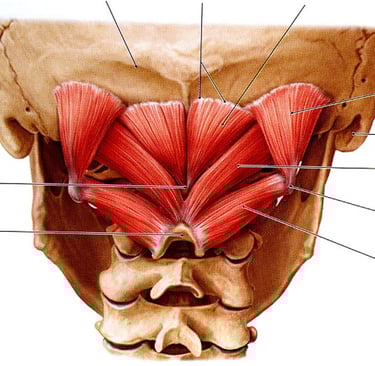
The suboccipitals are a group of small, deep muscles located just beneath the back of your skull. These include:
Rectus capitis posterior major and minor
Obliquus capitis superior and inferior
These muscles connect the skull to the upper cervical spine (C1 and C2) and are packed with proprioceptors — sensors that help your brain understand head position and movement.
They play a major role in:
Fine motor control of head and neck movement
Eye-head coordination
Posture
Stability of the upper cervical spine
How They Become a Problem After a Concussion or Car Accident
During a concussion, whiplash, or blow to the head, these tiny muscles can:
Become hypertonic (tight)
Develop trigger points
Irritate nearby nerves
Disrupt proprioceptive signaling
This creates a cascade of symptoms, including:
Tension headaches starting at the base of the skull and radiating forward
Eye pain or pressure behind the eyes
Blurry vision, especially after screen use or reading
Difficulty with gaze stability or head movement
Neck stiffness or pain with turning your head
If you've said, "My headaches start in my neck and move behind my eyes," — your suboccipitals are likely involved.
How the Suboccipital Region Affects Eye Function
The suboccipital muscles connect directly to the brainstem and cerebellum, which are involved in coordinating eye movements and balance.
They’re also tied into the cervico-ocular reflex (COR) — which helps keep your vision stable during head and neck motion. When the suboccipitals are irritated or tight:
Eye movement becomes less coordinated
Gaze stability is reduced
The brain gets conflicting sensory input
You may experience motion sensitivity, double vision, or trouble reading
In short, tight suboccipitals = more visual fatigue and more headaches.
Signs Your Suboccipitals Are Causing Problems
Patients from Lee’s Summit, Overland Park, North Kansas City, and Shawnee often describe:
“Band-like” headaches or pressure wrapping around the head
Pain that starts at the base of the skull and moves behind the eyes
Headaches triggered by reading or scrolling on a phone
Dizziness or nausea with neck movement
Light sensitivity or trouble focusing the eyes
Tightness or tenderness in the upper neck
How We Treat Suboccipital Dysfunction in Kansas City
At our clinic, Dr. Lance Stevenson, DC performs detailed assessments of the cervical spine, suboccipital region, and visual system to determine where symptoms are coming from.
We use targeted techniques to restore function, including:
✅ Manual release of the suboccipital muscles
✅ C1–C2 joint mobilization (safe, precise, and gentle)
✅ Trigger point therapy and stretching
✅ Head-eye coordination exercises to recalibrate the COR
✅ Postural and ergonomic adjustments (especially for desk and screen users)
✅ Visual-vestibular rehab when symptoms overlap with dizziness or motion sensitivity
We treat the root cause, not just the symptoms — helping you recover faster and more completely.
Still Struggling With Eye Strain or Headaches After a Concussion?
If your recovery has plateaued — and you're still dealing with headaches, blurred vision, or fatigue — your suboccipital muscles and upper neck may be the missing link.
At our Kansas City clinic, Dr. Lance Stevenson, DC helps patients from Parkville, Blue Springs, Gladstone, and The Plaza restore normal neck and visual function for long-term relief.
Call 816-226-7476 today to schedule your evaluation and get to the bottom of your symptoms — starting at the base of the skull.
Special thanks to Complete Concussions for their training and educational resources. To learn more about comprehensive concussion treatment options, visit completeconcussions.com.
Disclaimer:
This blog is for educational purposes only and is not intended to diagnose, treat, or replace medical advice. If you have experienced a concussion or other injury, please consult a qualified healthcare provider. Always follow the advice and treatment plan given by your medical professional.
Been in an Accident? Start Here.
Call us today for a free consultation or with any questions.
Expert Personal Injury Care
Whiplash Chiropractor in Kansas City
Lance@ChiroKC.com
816-226-7476
© 2025 Lance Stevenson, DC, LLC. All rights reserved.
Disclaimer: The content provided on this page is for informational and educational purposes only and is not intended as a substitute for professional medical, legal, or insurance advice. While every effort is made to provide accurate and up-to-date information, it should not be relied upon as the sole basis for decisions regarding your health, legal matters, or insurance claims. Please consult with your healthcare provider, attorney, insurance company, or other relevant professionals for personalized guidance tailored to your specific situation.
1010 Carondelet Dr., Suite 416
Kansas City, MO 64114